


Sanwa Dock Co., Ltd.

Industry: Ship repair and retrofit - Marine Engineering
Location: Onomichi-city, Hiroshima-pref, Japan
Website: www.sanwadock.co.jp

The Company
Founded in 1961, Sanwa Dock has dedicated its business exclusively to ship repair. For many years, the company specialized in the maintenance and repair of Japanese coastal vessels, building strong expertise and craftsmanship in the field. In 2016, Sanwa Dock expanded its capabilities with the construction of a dock for large ocean-going vessels, allowing the company to enter the international ship repair market. By combining decades of experience with modern facilities, advanced machinery and engineering technologies, Sanwa Dock is able to provide high-quality repair and modification services to shipowners worldwide.
The Challenge
Before adopting ThinkDesign, Sanwa Dock faced several challenges, as plant and piping layouts were primarily created using a 2D CAD solution, which made the design review process time-consuming and less efficient. In addition, ship repair and retrofit projects involve complex engineering challenges, as modifications must be designed around existing structures that often differ from the original plans. These conditions made it difficult to work efficiently, prompting Sanwa Dock to look for a CAD solution that could manage the complex geometries of real-world ship structures while enabling engineers to evaluate and implement designs, including relocating or removing existing equipment.
ThinkDesign as a Solution
Sanwa Dock selected ThinkDesign as its core design tool due to its powerful surface modeling capabilities and flexible geometry editing, which are essential for reverse engineering and ship retrofit projects. ThinkDesign also enables the creation of lightweight models containing only the essential information required for production and installation, allowing engineers to streamline the design process while maintaining accuracy and clarity throughout the workflow. It also allows simultaneous work on plant structures, piping, machinery and equipment, while also handling complex-shaped pipes and free-form surfaces. By delivering these advanced capabilities in a cost-effective and efficient environment, ThinkDesign offers Sanwa Dock a practical and versatile solution to address its diverse design challenges.
REVERSE ENGINEERING
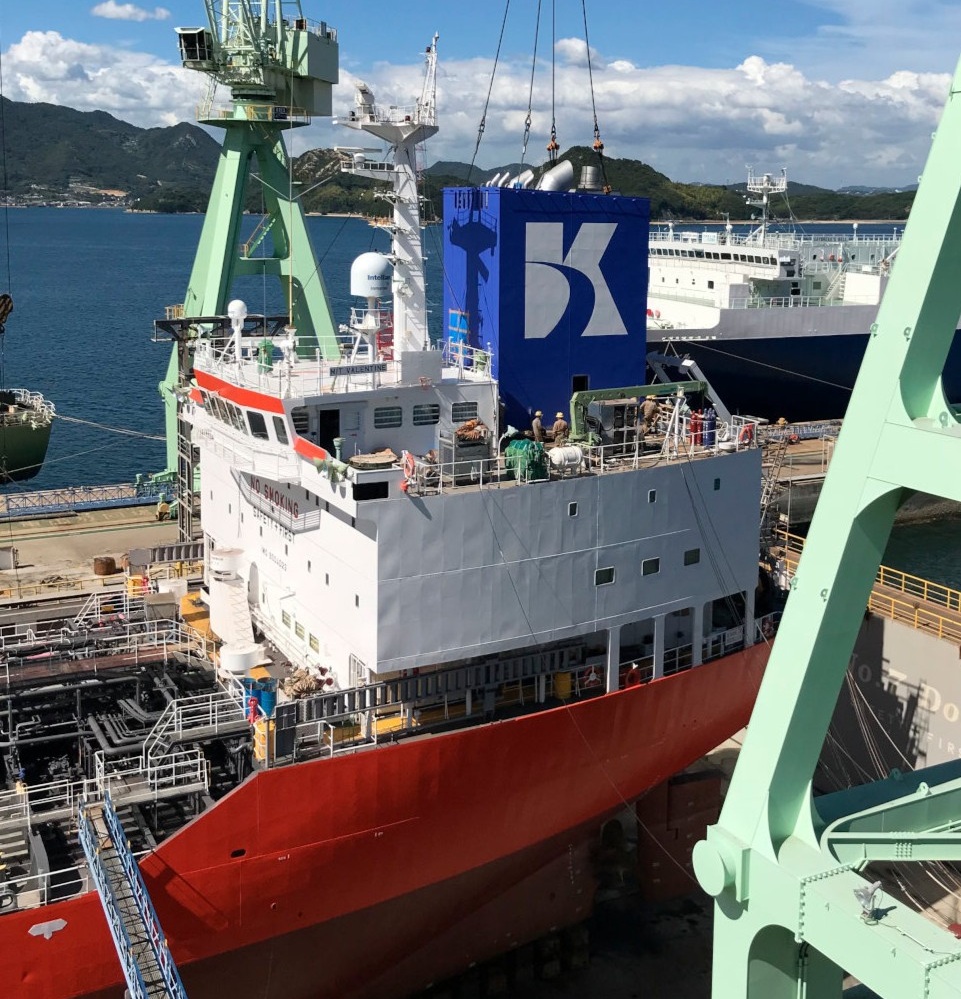
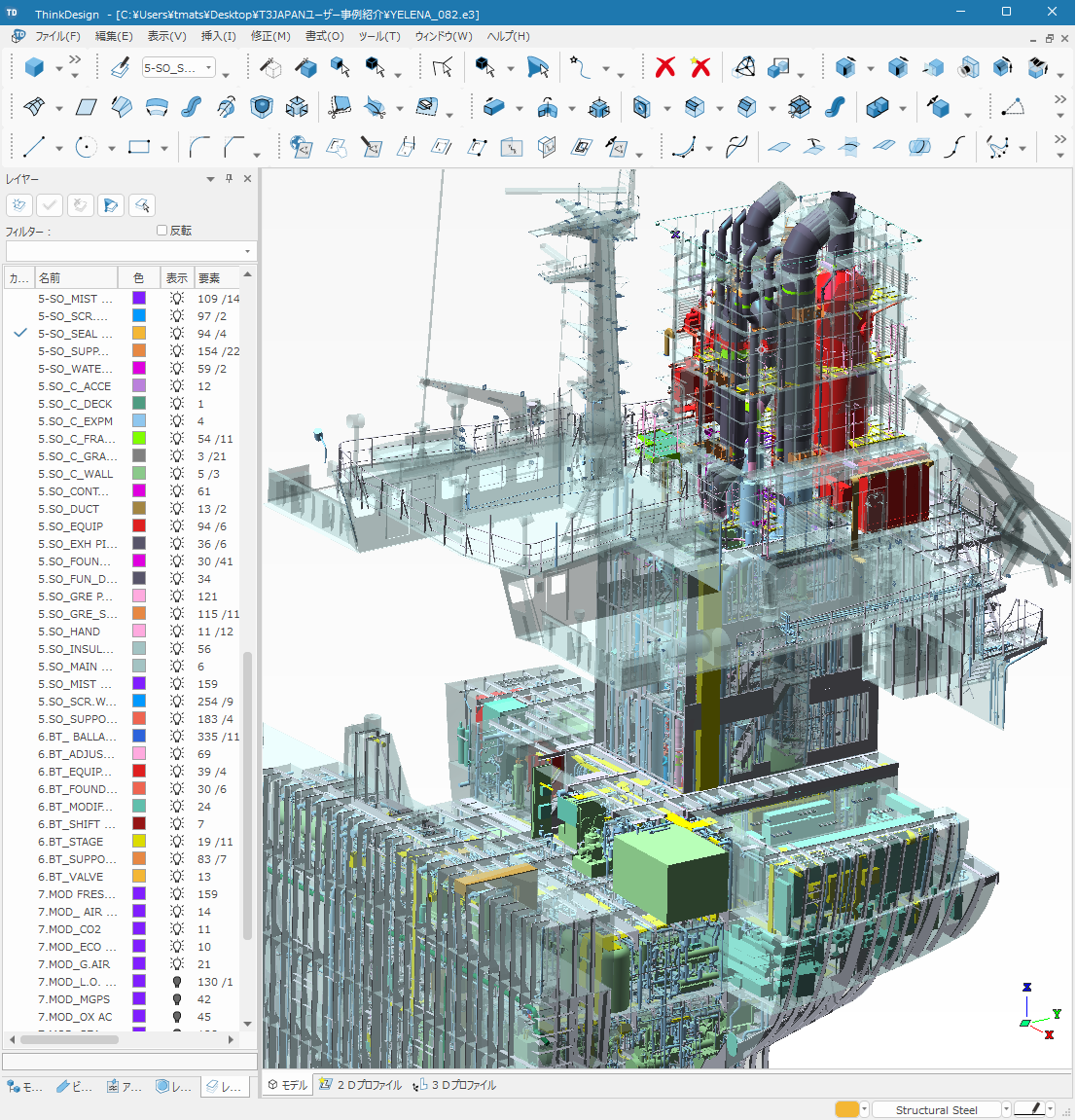
Ship repair and retrofit projects present unique challenges because engineers must work on existing vessels, where actual conditions often differ from the original drawings due to manufacturing variations, previous repairs or modifications. To accurately capture these conditions, Sanwa Dock relies on reverse engineering, for example for retrofits such as SOx scrubbers - systems required to meet stricter environmental regulations.
Ship structures are measured onboard using 3D laser scanning, generating point cloud data that is converted into 3D models and imported into ThinkDesign for design modifications and manufacturing preparation. Although these models often contain imperfect or incomplete geometry, ThinkDesign allows them to be managed as shells within the solid modeling environment, enabling engineers to move and edit them like standard solids.
One of the key advantages of ThinkDesign is its high level of modeling freedom, since it is not constrained by rigid modeling structures, allowing engineers to work more freely when dealing with irregular shapes. This flexibility is particularly valuable when modeling shell plating, piping systems, and structural components that must accurately reflect the distortions and variations found in real ship structures.
PIPING AND SURFACE MODELING
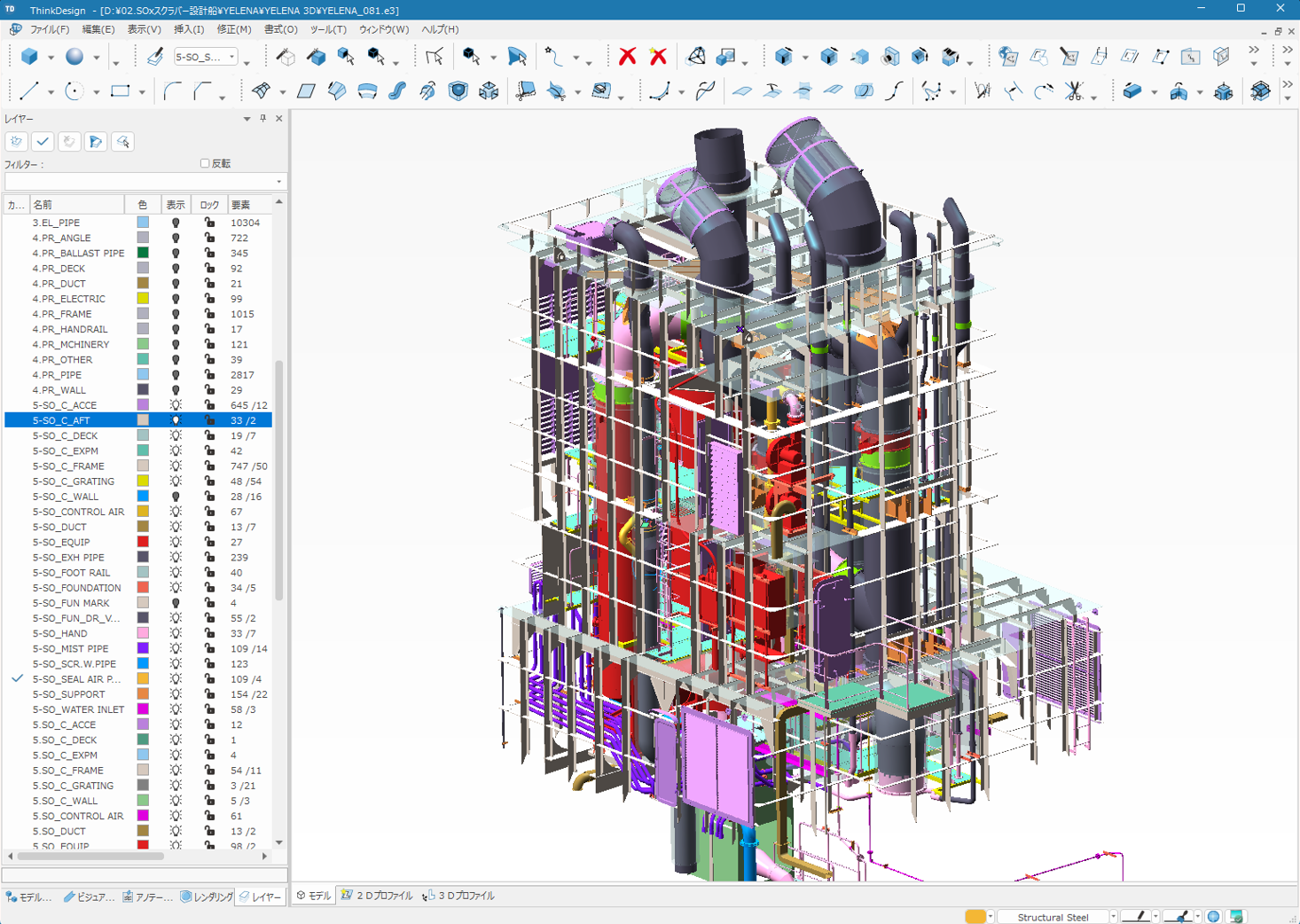
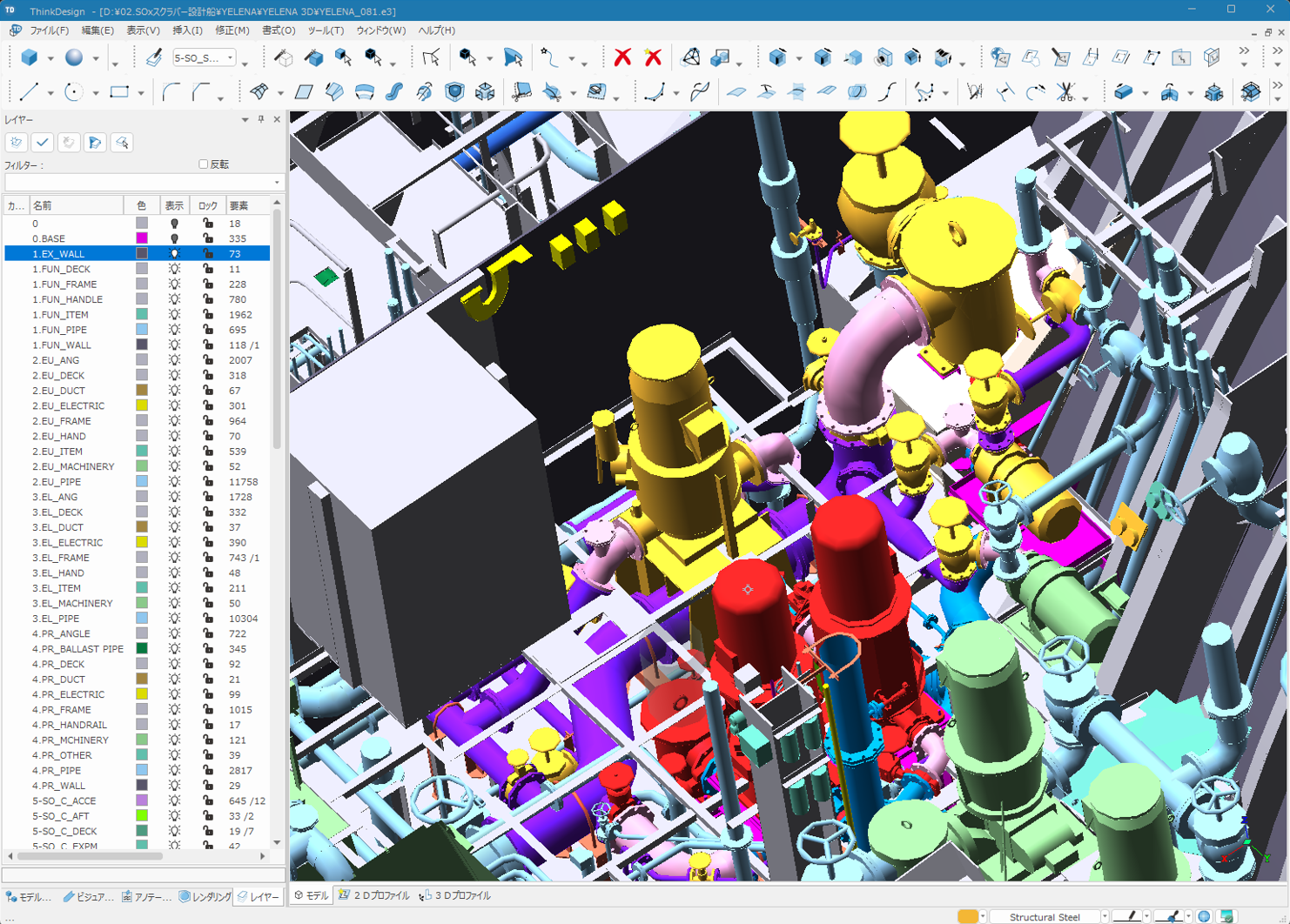
The design of piping systems is a critical aspect of vessel repair and modification projects. To support these activities, Sanwa Dock relies on ThinkDesign’s surface modeling capabilities. The software enables engineers to create both straight and curved pipe surfaces that follow complex routing paths within confined ship spaces. Pipes can be easily adjusted to fit around existing structures and to accurately connect with fittings and surrounding elements, without rebuilding the geometry. ThinkDesign also provides tools to quickly generate closing surfaces to fill openings or complete partially defined geometries - an essential capability when working with scanned data - ensuring clean and continuous models for further design development.
DIRECT MODELING
ThinkDesign’s Interactive Solid Modeling technology provides a flexible approach to editing both native and imported solid geometries, allowing designers to modify models without being constrained by the original parametric history. This capability is particularly valuable in shipbuilding, where engineers often need to adapt components originating from different sources or quickly adjust geometry during the design process. Within this workflow, Sanwa Dock frequently uses the Offset Faces command to modify steel profiles and plate thickness, enabling engineers to quickly adapt structural components to evolving design requirements without reconstructing the geometry.
Thanks to ThinkDesign, the impossible has become possible.
Ship repair rarely involves ideal geometry - every vessel is unique, and onboard structures often contain distortions or incomplete data. ThinkDesign lets us work directly with these complex surfaces and quickly adapt our designs to real ship conditions.
SOLID MODELING
Beyond interactive editing, Sanwa Dock also uses ThinkDesign’s solid modeling tools to develop and refine steel components associated with piping systems.
Designers can modify existing solids by adding or removing material, making it easy to create protrusions, openings or slots directly on current geometry. This flexibility enables to quickly adapt steel parts to evolving requirements, as well as to generate reinforcing elements and structural extensions starting from existing faces. For the creation of new structural components, ThinkDesign provides efficient tools particularly suited to modeling the steel elements commonly found in ship structures.
By combining these solid modeling capabilities with a flexible surface modeling environment, Sanwa Dock can manage both the design and adaptation of structural components with a high level of precision and efficiency.
Conclusion
By adopting ThinkDesign, Sanwa Dock has significantly improved its design efficiency and accuracy, gaining a versatile tool that combines surface-strong 3D modeling with interactive solid modeling. The company can now seamlessly integrate reverse-engineered data, adapt piping and structural components and execute modifications on vessels of any size.
ThinkDesign’s flexible modeling environment allows Sanwa Dock to quickly adapt designs to evolving requirements, streamline production, and ensure precise fit and installation, reducing rework and accelerating project delivery.
Overall, ThinkDesign has strengthened Sanwa Dock’s engineering capabilities, providing a practical, cost-effective solution that enables the company to deliver high-quality ship repair and modification services while supporting its growth and global presence. Guided by its love for ships and the sea, Sanwa Dock works in the spirit of craftsmanship, aiming to become a world-renowned repair dock and contributing to safe navigation at sea.